
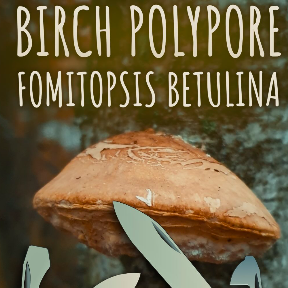

”Found on fallen birch, this bracket has been used by humans for thousands of years. It grows on dying or dead birch, weakly parasitic and saprophytic. Centuries ago, it was used as a tonic for the immune system and an antiseptic to clean wounds and promote healing.
GeorgeFlavour Fred
A plaster can be made from the underside of the ports, probably used by Bronze Age men to get rid of parasitic worms. It has numerous uses, from tinder to knife/blade sharpening. Scientific studies have proven that it contains many compounds with antiviral, antibiotic, anti-inflammatory, and anti-septic properties. It also refuses to share its chosen location with other mushrooms, making it anti-fungal and great for cleaning fungal infections (as in the 2nd World War). Additionally, it has immune-enhancing and immune-modulating properties, though it is powerfully bitter and can act as a laxative for those who try it.
Known as “Razor Strop,” it was used by people to sharpen cut throat razors, blades, and arrow heads. They would hit it with a mallet and dry it to compress it, repeating the process to get a dense leather. It is also used as leather in Romania. The 5,000-year-old mummy found in the Tyrol and nicknamed Ötzi the Iceman had two pieces of this fungus on a neck thong, but it seems unlikely that their purpose was to sharpen a razor.
Early humans also used the Birch Polypore with some kind of spark-producing implement, such as flint stones, to start campfires at new sites. It can also act as a transportable ember, similar to the Tinder Fungus or Hoof Fungus, making fire lighting easier.
The Birch Polypore is recognised as medicinal because its main constituents are beta glucans, triterpenes, phenolic acids, and non-water-soluble monosaccharides. The immune-enhancing and immune-modulating activity is largely due to the polysaccharides, particularly the beta-glucans, which make up around 52% of the mushroom.