
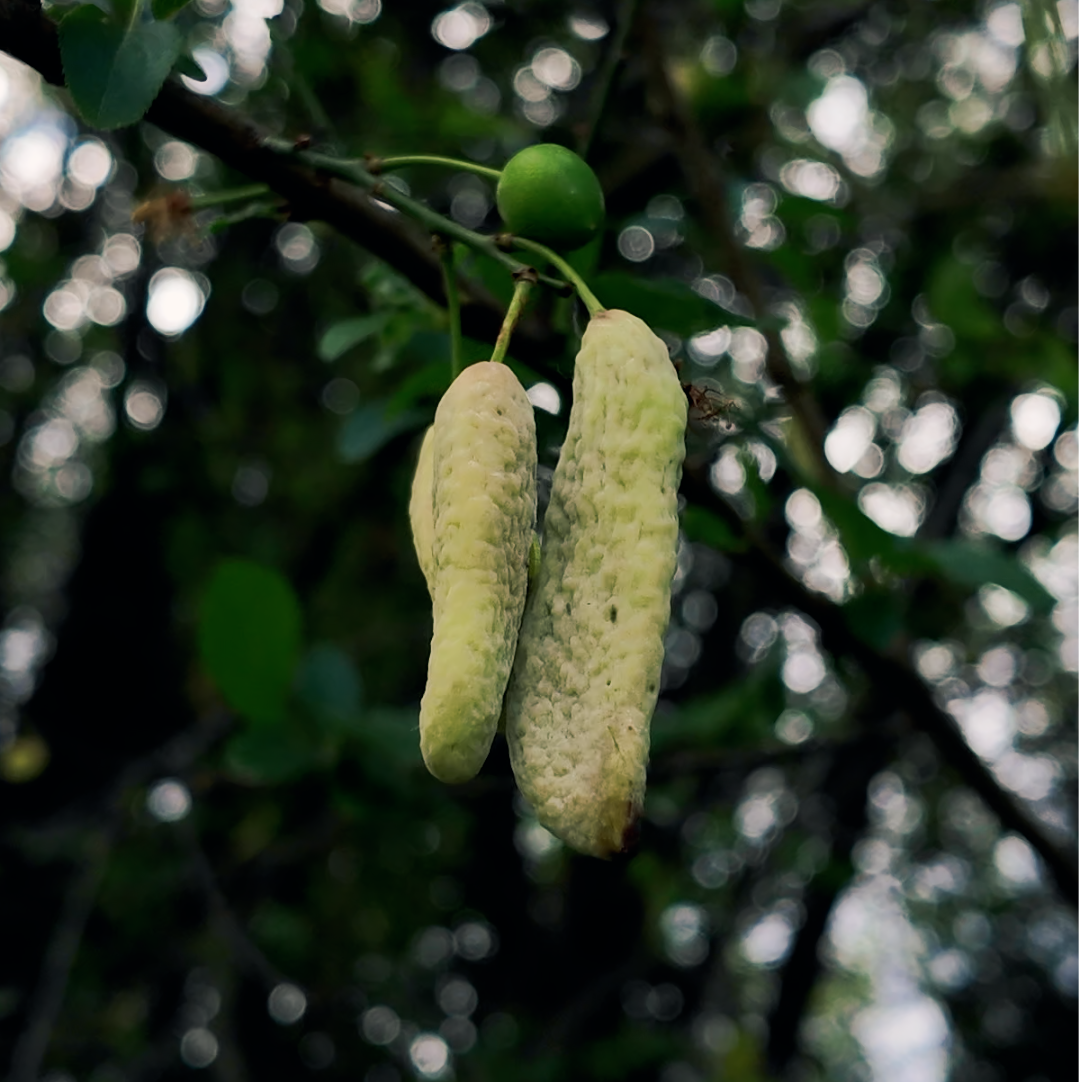

”Spotted these strange distorted, almost cashew-shaped fruits on Prunus lately? They’re not unripe. Not a different species. Not a mutation.
GeorgeFlavour Fred
This is a pocket plum — the work of a fungus rewriting the fruit from the inside out. Taphrina pruni infects the developing ovary shortly after flowering, usually following a mild, wet spring. Instead of forming a stone, the fruit is chemically hijacked. The endocarp (layer surround and protecting the seed) fails to develop and the plum elongates, warps and hollows into a sterile, bladder-like gall.
You never really see the fungus itself — only the transformation it causes. Later in spring the surface develops a pale bloom of asci (sacs of spores), before the fruits shrivel and fall without ever ripening.
Key features:
• Infection occurs at blossom stage
• Stone (endocarp) fails to develop
• Fruit becomes elongated, curved and spongy
• Pale powdery bloom develops later (asci, sacs of spores)
• Fruits dry, shrivel and drop prematurely
The fungus overwinters on buds, twigs and bark crevices, ready to infect again in cool, wet spring conditions. A fungus editing the fruit before a seed can even form — and quietly reducing this year’s crop before summer has begun.