
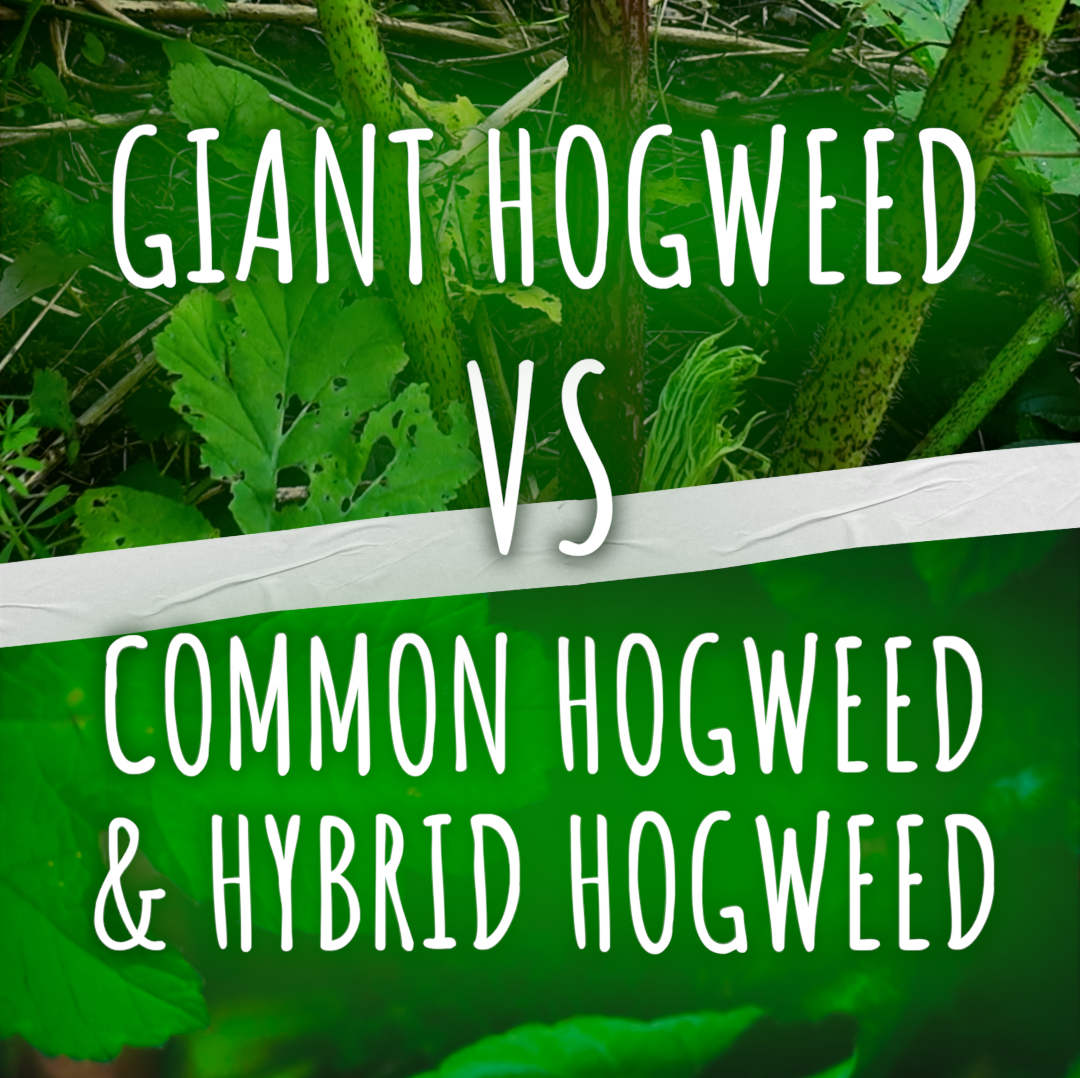

”Comparison of Common Hogweed & Giant Higweed + Hybrid
*Hogweed hybrid
(Heracleum sphondylium × Heracleum mantegazzianum)Not quite common hogweed. Not quite giant hogweed. But something in between. First recorded in County Dublin in 1951
GeorgeFlavour Fred
Across parts of Britain, the native common hogweed (Heracleum sphondylium) is quietly crossing with the invasive giant hogweed (Heracleum mantegazzianum), producing fertile hybrids that blur the lines between the two. These plants often inherit the height and vigour of giant hogweed, but with more variable leaf shapes, intermediate stem blotching, and umbels that don’t quite match either parent.

The result? A genetically messy middle ground. Plants that can be taller than common hogweed, more robust than expected, and sometimes just as phototoxic. The furanocoumarins — the chemicals responsible for severe phytophotodermatitis — don’t disappear in hybrids. In some cases, they remain very much present. Sunlight + sap = burns.
This hybridisation matters. It potentially increases the spread of aggressive traits into landscapes where giant hogweed itself might struggle, while making identification harder. Management becomes trickier when plants don’t fit the textbook description. Although the hybrid has limited fertility, backcrossing with native Hogweed is possible so any intermediate genotype might also be present in a population.
Additional characteristics of fruit, leaves and stems can also be used to differentiate the three taxa, most of them less easy to observe in the field.
Look for:
• Intermediate height (1.5–3 m) (COMMON HOGWEED: 1.3 – 2 m) (GIANT HOGWEED: greater than 2 m and usually more than 3 m)
• Irregular purple blotching (less dramatic than giant hogweed)
• Hairy stems but not always bristly, 19 – 45 mm diameter (COMMON HOGWEED: 10 – 25 mm diameter) (GIANT HOGWEED: 35mm diameter with purplish-red spots or blotches) • Leaf divisions broader than giant, but larger than common
• Primary umbel, 20-25cm diameter, 30 – 60 rays. Slightly dome-shaped or more-or-less flat-topped, often uneven (COMMON HOGWEED: 14 – 18 cm diameter, 10 – 29 rays. Usually flat-topped but can be concave or slightly domed.) (GIANT HOGWEED: At least 55 cm (usually more) in diameter, 50-120 rays. Dome-shaped and often with lower rays curving downwards)
• Fruit: 9.5 – 11 mm or more in length. Dorsal vittae (oil ducts) 0.3 – 0.6 mm wide at widest point. (COMMON HOGWEED: 6 – 10 mm in length. Dorsal vittae less than 0.4mm wide at widest point.) (GIANT HOGWEED: 9 – 14 mm in length. Dorsal vittae greater than 0.7 mm wide at widest point.
Source: https://thewildflowersociety.org.uk/wp-content/uploads/2022/01/Hybrid-Hogweeds.pdf
Where native meets invasive, evolution doesn’t ask permission. It just gets on with it.