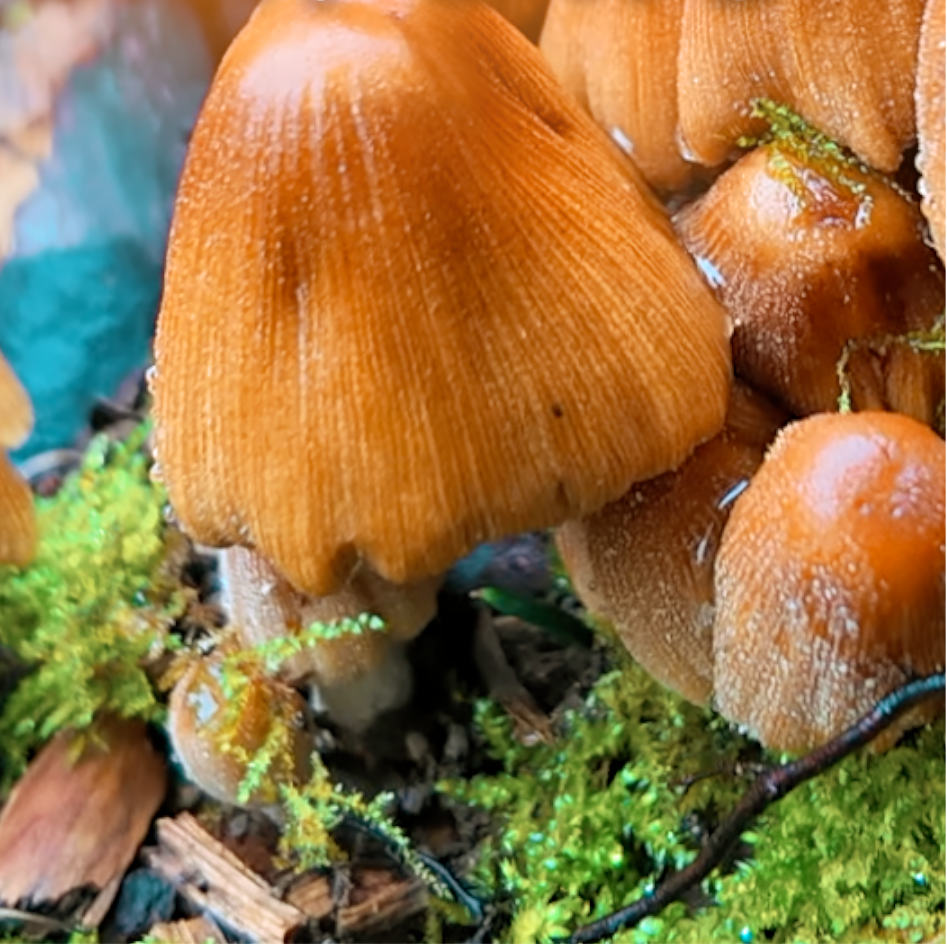

”The Glistening Inkcap, also known as the Mica Cap (Coprinellus micaceus), is a very common mushroom. It clusters around stumps and has a cap covered in mica-like granules. These granules are remnants of the universal veil the mushroom grows from, which glistens in the sunlight. The granules are easily washed off by rain, as seen in many of the images. When this happens, the Glistening Inkcap looks very similar to the Woodland Inkcap (Coprinellus silvaticus). While neither is a choice edible, it’s quite interesting to discover them in various stages of deliquescence, where it breaks down into a liquid from solid organic matter.
GeorgeFlavour Fred
Some “inkcaps” react with alcohol due to a mycotoxin called Coprine, although the Glistening Inkcap doesn’t. The main concern is the Common Inkcap (Coprinopsis atramentaria), which reacts with alcohol to cause “Coprinus syndrome”. This reaction inhibits the enzyme aldehyde dehydrogenase, crucial for alcohol metabolism. Consequently, acetaldehyde builds up, triggering an alcohol flush reaction. Because of this, the mushroom is often dubbed Tippler’s Bane.
The Glistening Inkcap (Coprinellus micaceus), formerly known scientifically as Coprinus micaceus, was reclassified into the Coprinellus genus in 2001. This reorganisation stemmed from phylogenetic analyses prompting a restructuring of many species previously grouped under the genus Coprinus. Essentially, closer analysis revealed that “inkcaps” belong to different families despite their shared characteristic of melting into a black goo. Other well-known inkcaps from various families include the Pleated Inkcap (Parasola plicatilis), the Hare’s Foot Inkcap (Coprinopsis Lagopus) and the Common Inkcap (Coprinopsis atramentaria). The Shaggy Mane or Shaggy Inkcap (Coprinus comatus) is another notable inkcap.