
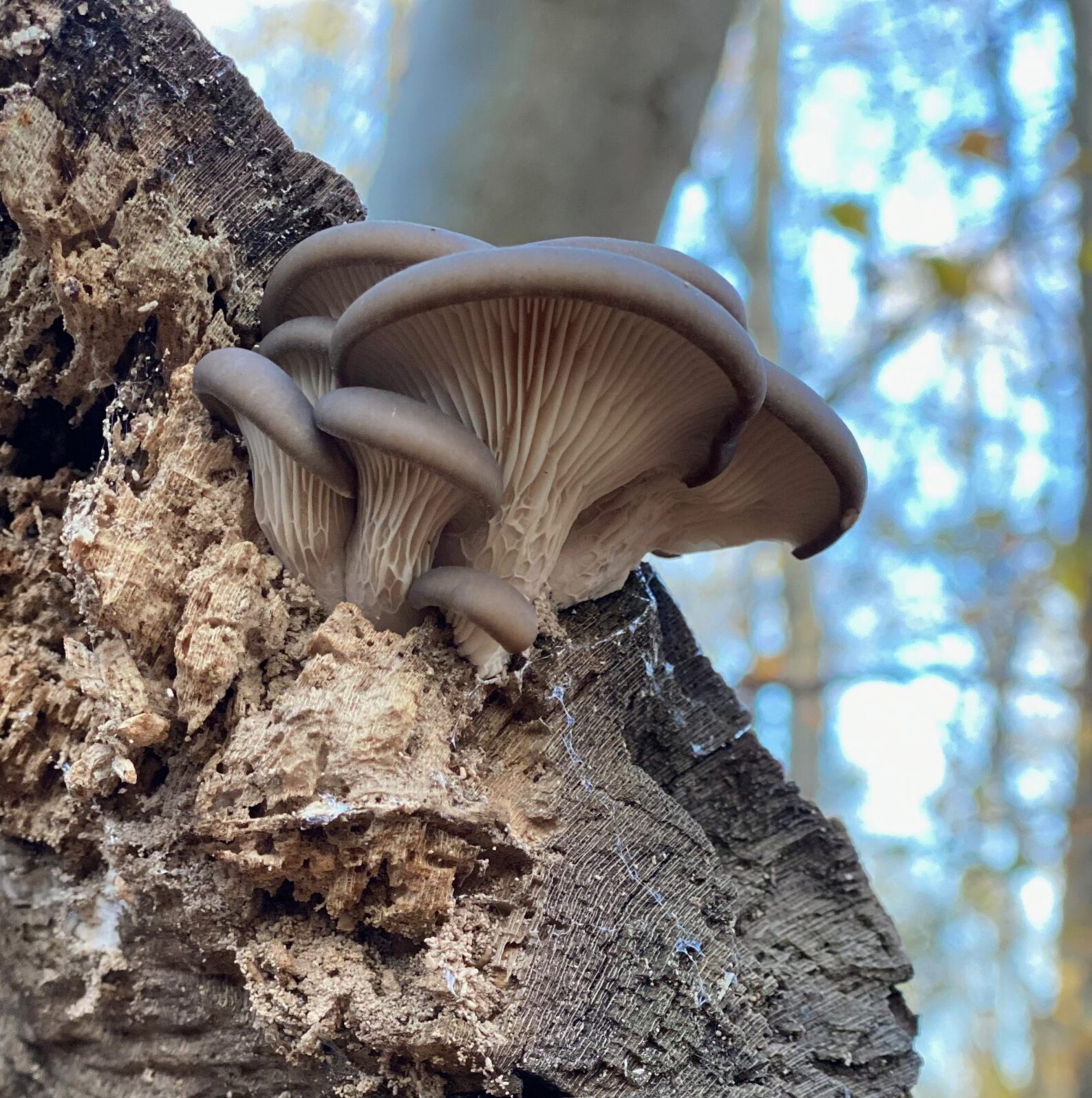

”These winter oyster mushrooms are one of my favourites to find and I’ll post what I made with them tomorrow. They grow frequently on beech trees where they prefer damaged and fallen trees branches and often cut logs or log piles. As omnivores, they obtain vital nitrates from passing nematodes, lassoing them in and extracting their nutrients. It’s quite the way to go! I spent some time thinking that if they mutated like in “The Last of Us” perhaps that process would happen to me. I’d be walking past a tree then all of a sudden I’d be lassoed by the mycelium, melted from the inside out and end up as a sac of skin on the floor. Anyway…flights of fantasy of fill@my mind as I wonder the woodlands. Some dreamy and other worldly but often quite obscure.
GeorgeFlavour Fred
Their firm texture makes them resilient to high temperatures, so they can withstand cooking over fire and direct onto coals in a basket. I’ve recently tried smoking them overnight and then cooking them in oil (confit) to preserve them. Check out my post on smoked and confit mushrooms for more details.
Always exercise caution when foraging for wild mushrooms and always do so with an expert. An oyster mushroom-like mushroom called Angel Wings (Pleurocybella porrigens) has been shown to contain compounds linked to catastrophic brain damage. Angel Wings are much smaller, paler and found on stumps or fallen trees in coniferous woodlands. The compound responsible for the risk is Pleurocybellaziridine, an unstable amino acid linked to brain damage. There’s plenty of research available if you’re interested in learning more. I haven’t seen Angel Wings at this time of year, usually late autumn.